Would you like a diagnosis confirmation
or a second opinion?

Description
43,336 new cases were reported in 2018 (24,035 men and 20,837 women).
Colorectal cancer is the second most common cancer in women (after breast cancer) and the third most common in men (after lung cancer and prostate cancer). This cancer is the second most common cause of cancer death in France: 17,117 colorectal cancer deaths were estimated in 2018 (9,294 men and 8,390 women). Nearly 85% of cases occur after age 65 and its frequency appears stable.
The colon and rectum contain different types of cells, each of which can cause a specific form of cancer. In most cases, colorectal cancers develop from the glands that line the inside of the colon and rectum. This form of cancer is called adenocarcinoma. They account for 90% of colorectal cancers.
In less than 5% of cases, other malignant tumors develop in the colon or rectum. These include carcinoid tumors, lymphomas, sarcomas, or melanomas.
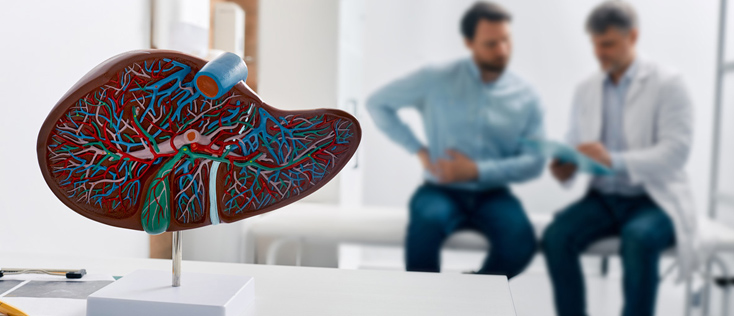
The estimated number of new cases of liver cancer in 2018 was 10,580, 77% of which were in men.
Hepatocellular carcinoma, or hepatocarcinoma, accounts for 90% of primary liver cancers. It takes its name from the liver cells from which it develops, hepatocytes. Hepatocellular carcinoma most often occurs in a liver damaged by disease. It can also occur in a person with a normal liver.
The liver can also be affected by metastases, that is, tumors formed from cancer cells that have broken away from a tumor located elsewhere in the body (for example, in the colon or breast). The treatments for primary liver cancer and liver metastases are completely different.
An estimated 5,445 new cases of esophageal cancer were diagnosed in France in 2018, 78% of which were in men.
The esophagus is the digestive tract that runs from the throat to the stomach.
Esophageal cancer most often develops from cells in the mucous membrane.
There are two main types of esophageal cancer: squamous cell carcinoma (the most common) and adenocarcinoma (cells of the glandular layer).
The number of new cases of stomach cancer in mainland France in 2018 is estimated at 4,657, 65% of which were in men.
Most stomach cancers develop from cells in the inner surface layer of the stomach (the mucosa). These cancers are called adenocarcinomas and account for about 90% of stomach cancers.
The number of new cases of pancreatic cancer in France in 2018 was estimated at 14,184, 51% of which were in men.
There are various malignant, or cancerous, tumors, the most common of which is adenocarcinoma. This represents 90% of diagnosed pancreatic cancers. It most often affects the head of the pancreas and develops from the cells that produce pancreatic juice, which is necessary for digesting food.
Treatments
Different types of treatments can be used to treat colorectal cancer: surgery, radiation therapy (for rectal cancers), chemotherapy, and targeted therapies.
This is the main treatment for colon cancer. It involves removing the portion of the colon affected by the tumor and the corresponding network of lymph nodes (this is called lymph node dissection). Depending on the location and extent of the tumor, a larger or smaller portion of the colon is removed. Since the colon is not a vital organ, it is possible to live normally even if a large part, or even all, of it is removed.
STOMIE
After removing the portion of colon affected by the tumor, the surgeon usually connects the two unaffected portions of colon to restore intestinal continuity. In some cases, it is necessary to rest the colon to promote healing. A temporary colostomy is then performed. Once the colon has healed, a new operation is scheduled to close the stoma and restore intestinal continuity. A permanent colostomy may be necessary following surgery for rectal cancer.
CHEMOTHERAPY
Chemotherapy is not routinely offered to all patients with colon cancer. In some cases, chemotherapy may be considered in addition to surgery, particularly if the tumor has aggressive characteristics.
If lymph nodes are affected by cancer cells, chemotherapy is recommended after surgery. Its aim is to reduce the risk of recurrence.
For cancers with metastases, chemotherapy, with or without targeted therapy, should be considered.
RADIOTHERAPY
Radiation therapy is generally not indicated for treating colon cancer.
It is sometimes used to treat certain isolated metastases or to relieve certain symptoms caused by the tumor, when it cannot be removed.
TARGETED THERAPIES
Targeted therapies are used in combination with chemotherapy for advanced colorectal cancer. These drugs are part of the monoclonal antibody family. Their role is to detect and neutralize certain foreign substances such as viruses or bacteria.
Four types of treatments can be used to treat primary liver cancer: surgery to partially remove the liver, liver transplant, destruction through the skin, and chemotherapy.
SURGERY
Partial liver removal surgery allows the tumor to be removed when the liver is functioning normally. A liver transplant (or liver transplantation) can also be performed. This allows both the removal of the tumor and the treatment of cirrhosis when the liver is no longer functioning normally.
Percutaneous tumor destruction
This is a detection through the skin and is an alternative to surgery for removing small tumors, when their location in the liver allows.
CHEMOTHERAPY
Chemotherapy is performed by chemoembolization or targeted therapy. It aims to reduce the size of the tumor and slow the development of the disease.
SURGERY
This is the standard treatment for localized cancers. Surgery involves removing all or part of the esophagus (esophagectomy). Reconstructive surgery, most often using the stomach, is performed at the same time to restore continuity to the digestive tract.
CHEMOTHERAPY / RADIOTHERAPY
Sometimes, chemotherapy combined with radiotherapy (called chemoradiation) alone or preoperative (or neoadjuvant) chemotherapy may be offered.
For locally advanced cancers, preoperative chemoradiotherapy is the usual treatment. It may be offered alone if there is a contraindication to surgery.
For metastatic cancers, chemotherapy alone is the standard treatment. It can help slow the progression of the disease, relieve symptoms (particularly reducing pain), and improve quality of life.
Several treatments can be used, alone or in combination, to treat stomach cancer: surgery, chemotherapy, radiation therapy and, more rarely, endoscopic treatment.
SURGERY
The surgery performed to treat stomach cancer is a gastrectomy. Depending on the location of the tumor and its stage, the surgeon removes all of the stomach (total gastrectomy) or part of it (partial gastrectomy).
The procedure is combined with lymph node dissection. This involves the removal (or excision) of lymph nodes located near the stomach. This allows for the presence or absence of cancer spread to be assessed.
Reconstructive surgery is performed at the same time to restore continuity of the digestive tract.
CHEMOTHERAPY
Chemotherapy may be offered in several situations.
The cancer is at a localized stage: chemotherapy performed before and after surgery may be scheduled for certain cases of localized cancer. Before surgery, it makes it easier to remove the tumor by reducing its size.
For locally advanced, operable cancers: chemotherapy performed before and after surgery is the standard treatment.
In the case of metastatic cancer or unresectable tumors: chemotherapy alone is the standard treatment. It can help limit the progression of the disease, relieve symptoms caused by the tumor and metastases, and improve quality of life. This is called palliative chemotherapy.
RADIOTHERAPY
Radiotherapy can be offered:
To treat certain locally advanced cancers after surgery and most often in combination with chemotherapy
To reduce the symptoms of the disease in very advanced tumors that have or have not benefited from surgery.
ENDOSCOPY TREATMENT
For superficial stomach cancers, endoscopic treatment may be an alternative to surgery. It involves detaching and removing the entire mucosa and submucosa of the stomach.
SURGERY
It removes the tumor by removing the part of the pancreas where it has grown. Neighboring organs or parts of organs to which cancer cells may have spread are also removed. This treatment can only be performed in the absence of other diseases that prevent surgery or increase the risk of complications related to the operation.
CHEMOTHERAPY
It can slow down or even stop the development of the tumor and/or metastases if surgery is not possible. Chemotherapy is sometimes combined with radiotherapy.