
Would you like a diagnosis confirmation
or a second opinion?

Description
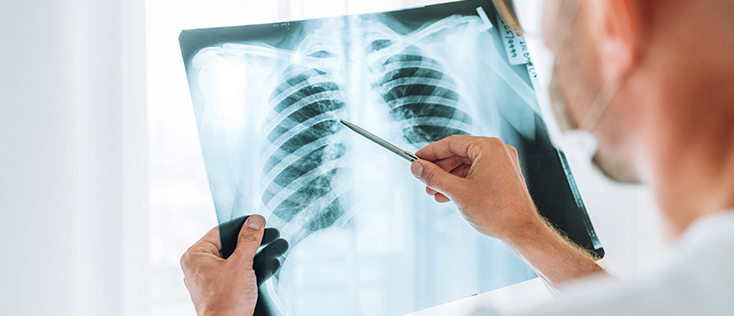
The number of new cases of lung cancer in mainland France in 2018 was estimated at 46,363, 67% of which were in men.
Lung cancer is the second most common solid tumor in men and the third most common in women.
The lung can contain benign (noncancerous) or malignant (cancerous) tumors. The major difference between benign and malignant tumors lies in the former’s inability to migrate to other parts of the body (metastasize).
Among the malignant tumors that can affect the lungs, some are called primary when they originate in the lung. Others are called secondary when they have spread to the lung from another organ. Secondary tumors are called metastases.
Treatments
Three types of treatment can be offered for the management of lung cancer or bronchial cancer: surgery, radiotherapy, and medical treatments, i.e., medications (chemotherapy or targeted therapies). They can be prescribed alone or in combination.
SURGERY
The goal of surgery is to completely resection – remove – the tumor. This is called a “radical” procedure, the aim of which is curative.
There are two main types of interventions:
- Lobectomy: The surgeon removes a lobe of the lung.
- Pneumonectomy: one of the two lungs is completely removed.
These procedures are always accompanied by removal of the surrounding lymph nodes (lymph node dissection).
THORACIC RADIOTHERAPY
In the treatment of bronchial cancer, external radiotherapy at the thorax level aims to irradiate the tumor and its periphery as well as the locoregional lymph nodes.
For non-small cell lung cancer (NSCLC):
- reference treatment, associated with chemotherapy
- as part of multimodal treatment
- an alternative to surgery in the event of unresectability of the tumor or inoperability of the patient
- in addition to surgery and chemotherapy
- in the treatment of metastases (cerebral irradiation, bone irradiation, etc.).
localized small cell lung cancers (SCLC): radiotherapy usually combined with chemotherapy is the standard treatment.
STEREOTAXIC RADIOTHERAPY
This technique, available at the CGFL since 2008, requires specific and rigorous preparation: the patient is first immobilized with their arms raised in a ball mattress, which, once emptied of its air, will take on the patient’s shape. This is then covered with a plastic envelope placed on the patient, also creating a vacuum, which allows for very high reproducibility of the patient’s positioning at each session.
To take into account the movement of the tumor with breathing, a 4D dosimetric scan is performed to decompose the scan images according to the different respiratory times. The tumor is contoured on each phase, the final tumor volume representing the sum of all the contours; this step is necessary to ensure that the tumor is always in the treatment field, regardless of the patient’s breathing.
In addition, a repositioning scan is performed before each session using the accelerator’s onboard imaging system. In total, the equivalent biological dose delivered is greater than 100 Gy, which is significantly higher than the doses delivered by conventional irradiation, allowing local control rates of more than 95%.
Furthermore, stereotaxic radiotherapy has the advantage of being very well tolerated and can also be performed on patients with respiratory failure who are inaccessible to surgical treatment or conventional external radiotherapy.
CHEMOTHERAPY
Chemotherapy molecules act on cell division mechanisms to destroy cancer cells.
Chemotherapy destroys cancer cells throughout the body.
TARGETED THERAPIES
In the treatment of non-small cell lung cancer, a targeted therapy molecule may be combined with chemotherapy.